Ballarò Market in Palermo: What to Eat, What to Buy and When to Go
Ballarò is Palermo's biggest and oldest street market, and it still works the way a market should. People come to buy dinner. The fish sits on ice on trestle tables, the fruit is stacked in wooden crates, and the street food is cooked for whoever is standing in front of the stall, tourist or not.
It runs through the Albergheria quarter, from the area around Piazza Casa Professa down toward Corso Tukory, along Via Ballarò and the lanes either side. The name probably comes from Arabic. One theory links it to Balhara, a village near Monreale whose traders brought goods here, which would put the market's roots in the tenth century. The street layout you walk through today was planned in the late 1400s.
Four plates on a tray
Order from a seafood stall with seating and you might end up with something like this: a black tray, a tablecloth printed with lemons, and four paper plates.
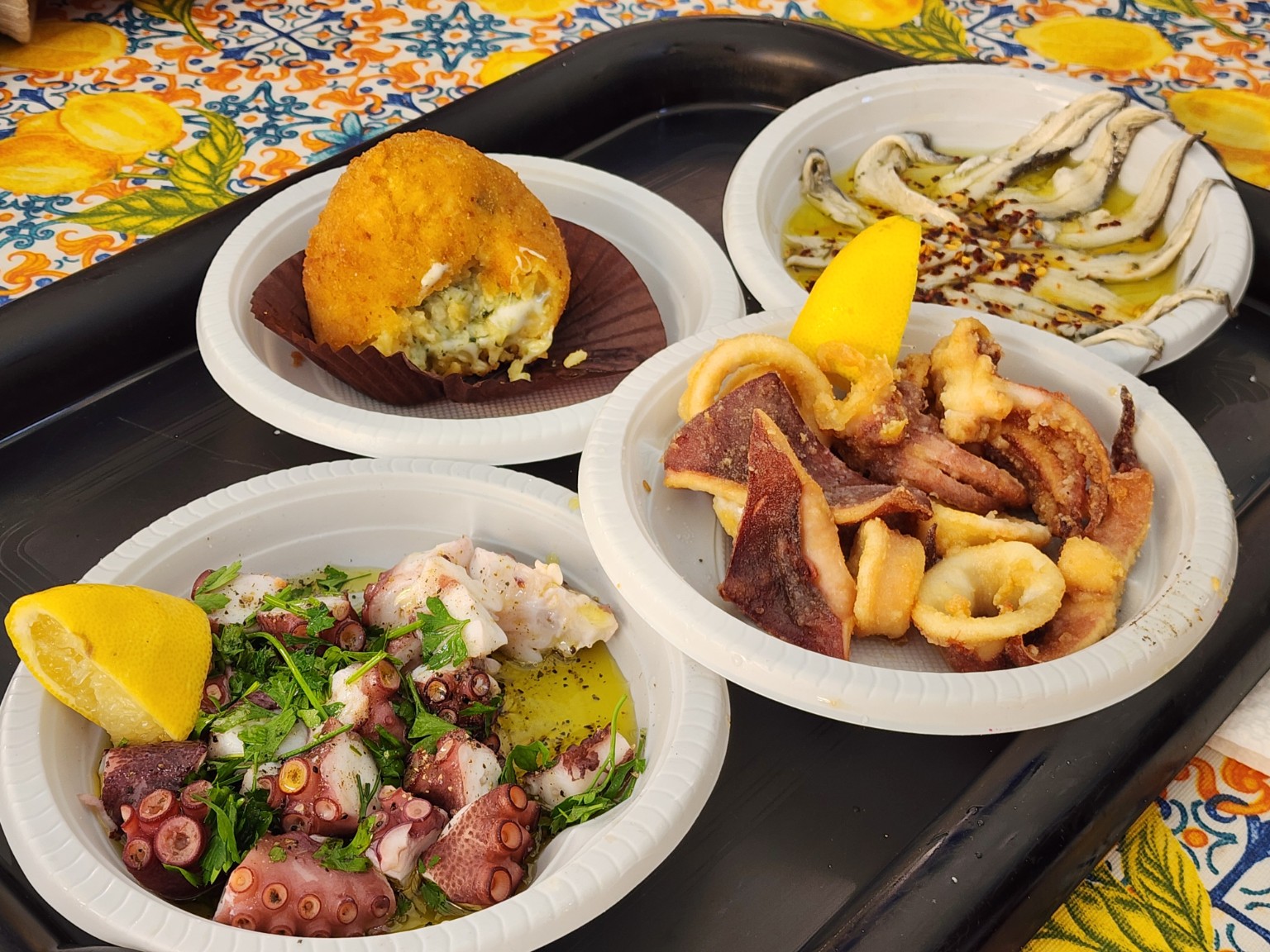
Front left, boiled octopus cut into chunks, dressed with olive oil and a pile of chopped parsley, a lemon wedge on the side. Next to it, fried calamari and squid in a mix of rings and tentacle pieces, darker where they caught the oil. At the back, white marinated anchovies lying in oil with flakes of red chilli. And one golden arancina, bitten open, the rice and filling showing.
That's a fair lunch for two. It's also a good map of what Ballarò does best.
What to eat at Ballarò
Polpo bollito. Boiled octopus is one of the market's oldest street foods. It's cooked whole, cut to order and dressed simply. It should be tender with a little bite. If it's rubbery, move on.
Alici marinate. Fresh anchovies "cooked" in lemon or vinegar, then dressed with oil, garlic, parsley or chilli. Sharp and clean, a good counterweight to the fried stuff.
Frittura. Calamari, small fish, sometimes prawns, fried and salted. Eat it hot or not at all.
Arancina. Palermo's rice ball, round and feminine here. Meat ragù or ham and mozzarella are the classics.
From the other stalls: pane e panelle (chickpea fritters in a sesame bun), crocchè (potato croquettes), sfincione (Palermo's thick, spongy pizza with onion and breadcrumbs), and for the brave, pani ca' meusa, the veal spleen sandwich. Toward evening the stigghiola grills light up and the smoke tells you where they are.
Street food here runs about €2 to €3 a piece as of late 2026. A seafood plate costs more and the price depends on weight and the stall. Ask before they start cutting.
What to buy
Even if you're not cooking, a few things travel well: dried oregano on the stem, capers in salt, sun-dried tomatoes, wild fennel seeds, almonds and pistachios. In winter the citrus is the best reason to bring a bag: blood oranges, mandarins, lemons with leaves still on.
If you do have a kitchen, buy fish. The swordfish heads on the counters are for show; the steaks are the point.
When to go
Morning, ideally before 11, when the produce is freshest and the stalls are loudest. That's when you hear the abbanniata, the vendors' sing-song calls advertising what they've got and what it costs.
Listed hours are 7:00 to 19:30 Monday to Saturday and 7:00 to 13:00 on Sunday, though stalls keep their own time and plenty pack up by mid-afternoon. On Sunday mornings the market takes on a flea-market side as well, with secondhand goods next to the food.
Keep your phone and wallet in a front pocket, wear shoes you don't mind getting wet near the fish, and carry small cash. Many stalls take cards now. Not all of them, and not always for a €2 panelle.
For a first-person walk through Ballarò and its street food, see Ballarò market on Travel Marketing. The grill at the other end of this market has its own post here.